You slept eight hours and woke up foggy anyway. Coffee usually takes the blame, or the mattress, or the late scroll through your phone, and most mornings one of them is the real culprit. But there’s a stranger suspect sitting 93 million miles away. When the Sun gets restless, it stirs Earth’s magnetic field, and a surprising amount of life on Earth seems to feel the nudge.
Look at the animals that live by that field. A songbird the size of your fist can leave Canada in autumn, cross a thousand miles of open water, and land on the same Caribbean shrub it used last year. No map. No GPS. It reads the planet itself, sensing Earth’s magnetic field like a compass wired into its body.
And that field isn’t fixed. The Sun keeps nudging it with flares, coronal mass ejections, and the geomagnetic storms they set off. Those nudges reach migrating birds, sea turtles, and the person reading this.
Many animals, from birds to sea turtles, navigate by reading Earth’s magnetic field, and a geomagnetic storm makes that field wobble. The same disturbance that scrambles a songbird’s migration shows up in people too, as measurable shifts in sleep, mood, and even heart-attack risk. The effects are small but real, and almost nobody thinks to look for them.
Plenty of organisms, including humans, seem to register the Sun’s mood, even without a compass anyone can point to. Some of it is settled science. Some is still being worked out.
The Animal Kingdom’s Hidden Compass
A surprising number of animals can navigate using Earth’s magnetic field, a sense called magnetoreception. Some do it with specialized cells, some with light-driven chemistry inside their eyes, and a few seem to use both at once.
Birds and Their Magnetic Maps
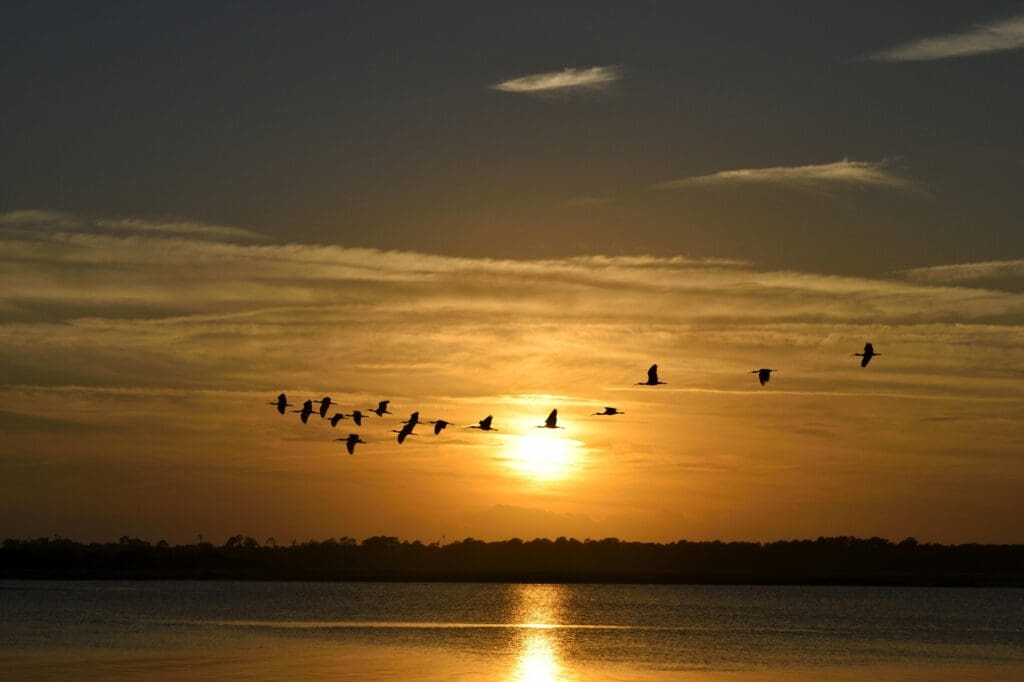
Migratory birds carry an internal compass, and the leading explanation sits inside their eyes. Light-sensitive proteins called cryptochromes appear to respond to the magnetic field through a quantum effect, giving birds a directional read laid over what they see.[1] (Yes, the working theory is that the bird may literally see the field as a pattern.)
And this is where the Sun comes in. When a geomagnetic storm rattles that field, the signal gets noisy. A 2023 study in PNAS found 9 to 17% fewer birds aloft on nights of strong geomagnetic disturbance, and the ones that did fly drifted more with the wind instead of fighting it (Gulson-Castillo et al., 2023). The compass still works. It just gets harder to read.
Sea Turtles: Journeys Across Oceans

A loggerhead hatchling scrambles into the surf, swims off across an entire ocean basin, and decades later (loggerheads can take 20-plus years to mature) comes back to nest near the beach where it was born. How? It seems to memorize the magnetic signature of its home coast, a trick called geomagnetic imprinting. When biologists matched 19 years of loggerhead nesting against slow drift in the magnetic field, the turtles clustered right where the field lines predicted they would.[2]
Insects and Fish

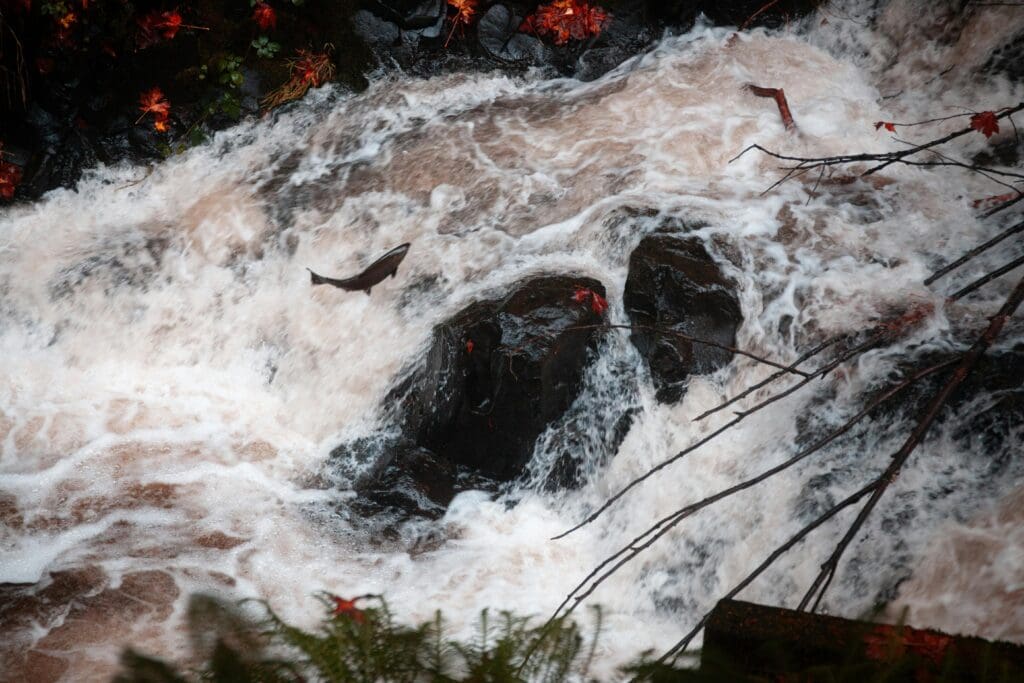
Monarch butterflies make the same kind of trip on tissue-paper wings, up to 3,000 miles to central Mexico. They steer mostly by the Sun, but when clouds move in they fall back on a light-dependent magnetic compass tucked into their antennae. Salmon do it underwater. A 56-year record of Fraser River sockeye showed the fish choosing their route home around Vancouver Island based on the magnetic field they imprinted on as young smolts, favoring the passage whose signature best matched their birthplace.[3]
Mechanisms Behind Magnetoreception
So how does a living cell feel something as faint as a magnetic field? Two main ideas, and they aren’t mutually exclusive.
Cryptochromes and Magnetic Sensing
Cryptochromes aren’t a bird-only gadget. Plants have them, insects have them, and so do you, where they help run your circadian clock. When researchers dropped the human version into magnetically sensitive fruit flies, it restored the flies’ magnetic compass.[4] That’s a genuinely striking result, and it’s worth being precise about what it means: the human protein can act as a magnetosensor in a fly. It does not show that you, personally, feel the field.
Iron-Based Magnetoreceptors
The second idea is more literal: tiny crystals of magnetite, a naturally magnetic iron oxide, sitting inside cells and swinging like compass needles. Honeybees carry permanently magnetic material in their abdomens, the kind of magnetite that keeps its own magnetization even after the outside field is gone.[5] Researchers have since found similar iron-rich structures in other animals, including some fish. A biological compass, built from rust.
Can You Feel Solar Weather? Sleep, Heart, and Mood
We don’t have a magnetite organ anyone can point to, and nobody has found a human magnetic compass. But “no obvious organ” isn’t the same as “no effect,” and a growing stack of studies finds our bodies quietly tracking geomagnetic activity in ways we didn’t expect.
Circadian Rhythms and Melatonin
Start with sleep. Melatonin is the hormone that tells your body it’s night and anchors your circadian rhythm. When researchers tracked 153 electric utility workers, the men put out less of melatonin’s main breakdown product on mornings after higher geomagnetic activity.[6] That study measured the hormone’s byproduct in urine, not how anyone actually slept, so the jump to a rougher night is a fair hunch rather than a proven link. Geomagnetic activity also runs strongest near the poles, so the farther north you live, the louder the Sun’s vote in your night may be.
Cardiovascular Effects
Your heart is the most-studied piece of this. Start with the baseline, because it frames everything that follows: your odds of a heart attack on any single day are low, and they stay low here. With that anchor in place, the pattern is real but modest. Studies find heart attacks tend to run a bit higher during geomagnetic storms, with the relative risk landing roughly 30 to 50% above quiet-day levels in a 2025 review.[7] That’s a correlation, not proof the storm pulled the trigger, and a 30 to 50% lift on a small daily number is still a small number. Diet, blood pressure, and smoking dwarf anything the Sun does. We dug into this in Solar Storms and Your Heart.
One thing here is never modest: the symptoms themselves. If you ever feel chest pressure, shortness of breath, or pain spreading into an arm or your jaw, treat it as an emergency and call 911 right now. That holds on a calm day and a stormy one alike. A space weather forecast never changes how fast you should react (American Heart Association).
Mood and Mental Health
Mood may move too. Combing through years of psychiatric admissions, R.W. Kay found that depression admissions among men ran about a third higher in the second week after a geomagnetic storm than in calm stretches.[8] One reading is that a storm works like a mild environmental stressor, tugging on the same hormonal and neurological dials that sleep and stress already pull. It’s a correlation across a population, not a verdict on anyone’s bad week.
From Lab Benches to Five Countries: What the Science Shows
Correlation is cheap. The interesting question is whether you can catch the effect under controlled conditions, and whether it still shows up at population scale. Both, it turns out.
Building a Storm in the Laboratory
In the lab, you can build the storm. A 2024 experiment ran rats through a heart-injury model, the ischemia-then-reperfusion that mimics a heart attack and the rocky recovery after one, under simulated geomagnetic fields of different strengths. In that study, weak simulated activity tracked with better recovery, shrinking the damaged zone and quieting inflammation, while severe simulated storms tracked with the opposite. The researchers read those swings off markers of inflammation and oxidative stress in the heart muscle.[9] That matters because a controlled experiment can do what a chart of coincidences can’t: it can point at cause. (One animal study, mind you, not a ruling on your Tuesday.)
The Epidemiology, Across Five Countries
At the other end of the scale, you can count people. Pooling 11,453 stroke cases across New Zealand, Australia, the UK, France, and Sweden, researchers found strokes ran about 19% more common during geomagnetic storms than on calm days.[10] Same footnote as the heart numbers: that’s a correlation across big populations and a small lift on an already-low daily risk, not something any one person would feel coming. Careful design, large sample, same direction as the heart and mood data. The signal keeps showing up.
And strokes carry their own can’t-wait checklist, storm or no storm. If a person’s face suddenly droops, an arm drifts down, or their words come out slurred, call 911 that minute. Brain cells die fast, and the space weather has nothing to say about it (American Stroke Association).
When Solar Storms Reach Your GPS and the Power Grid
The Sun doesn’t stop at biology. The same storms ripple through the machines we lean on. A strong solar flare smears GPS accuracy, and that error trickles down from aircraft navigation all the way to the blue dot on your phone. Power lines have a different problem: a geomagnetic storm drives stray currents through them, which in a severe event trips equipment or drops a city into the dark. Overhead, the extra radiation rattles satellites, the ones running your internet, your TV, and a good slice of global communications.
What a Solar Weather Forecast Actually Buys You
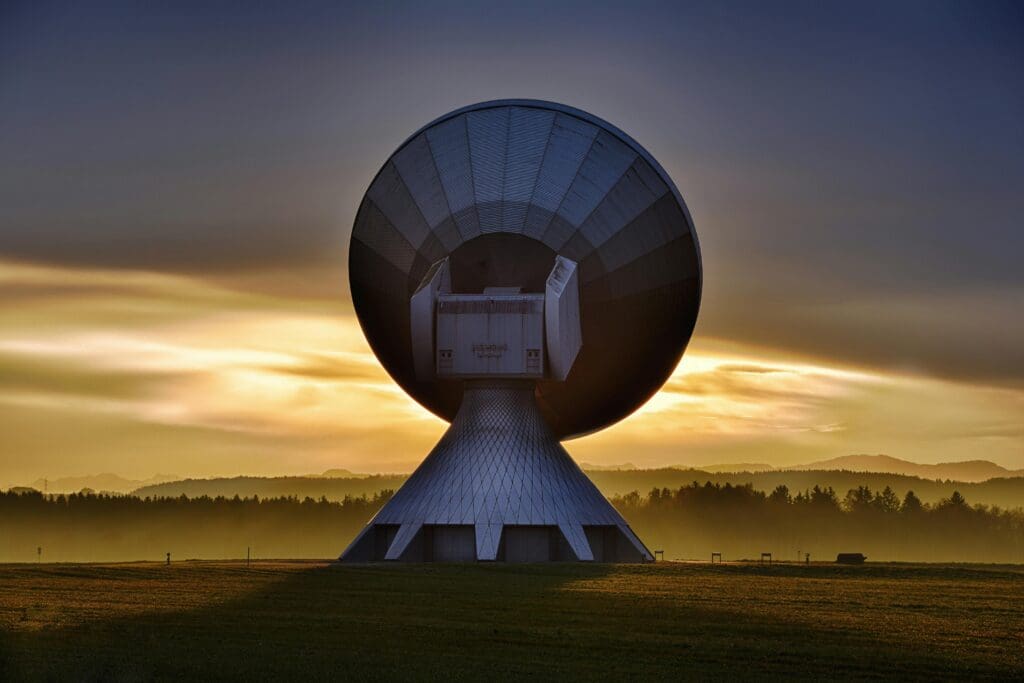
Knowing a storm is coming turns a surprise into a plan. Airlines and space agencies reroute flights and push back spacewalks, keeping crews out of the worst of the radiation. Grid operators get busy too, staging repair crews and bracing equipment before the currents arrive. The rest of us get something quieter. A forecast is mostly context, a reason a foggy-headed Tuesday or a restless night might not be entirely on you. (Not an excuse. Just a fuller picture.) None of this means watching the sky for permission to take your health seriously. It means carrying one more piece of information in your pocket.
Stay Ahead of the Sun with FlareAware
You can’t feel a geomagnetic storm rolling in, but you can know one’s on the way. FlareAware sends plain-language alerts when solar weather kicks up, so the science on this page becomes something you can actually use, whether you’re protecting sensitive gear or just curious why the starlings outside look a little lost today. See how it works at FlareAware.com.
Last thing, and it’s an honest one: this is general information, not medical advice. If your sleep or your heart feels tangled up with the Sun’s moods, take that to a doctor who knows your history, not to a forecast app. The starlings navigate by the Sun. You get to navigate by better information than that.
References
- Hore PJ, Mouritsen H. The Radical-Pair Mechanism of Magnetoreception. Annual Review of Biophysics. 2016;45:299–344. https://doi.org/10.1146/annurev-biophys-032116-094545 – Back to text
- Brothers JR, Lohmann KJ. Evidence for Geomagnetic Imprinting and Magnetic Navigation in the Natal Homing of Sea Turtles. Current Biology. 2015;25(3):392–396. https://doi.org/10.1016/j.cub.2014.12.035 – Back to text
- Guerra PA, Gegear RJ, Reppert SM. A magnetic compass aids monarch butterfly migration. Nature Communications. 2014;5:4164. https://doi.org/10.1038/ncomms5164. Putman NF, Lohmann KJ, Putman EM, Quinn TP, Klimley AP, Noakes DLG. Evidence for Geomagnetic Imprinting as a Homing Mechanism in Pacific Salmon. Current Biology. 2013;23(4):312–316. https://doi.org/10.1016/j.cub.2012.12.041 – Back to text
- Foley LE, Gegear RJ, Reppert SM. Human cryptochrome exhibits light-dependent magnetosensitivity. Nature Communications. 2011;2:356. https://doi.org/10.1038/ncomms1364 – Back to text
- Gould JL, Kirschvink JL, Deffeyes KS. Bees Have Magnetic Remanence. Science. 1978;201(4360):1026–1028. https://doi.org/10.1126/science.201.4360.1026 – Back to text
- Burch JB, Reif JS, Yost MG. Geomagnetic activity and human melatonin metabolite excretion. Neuroscience Letters. 2008;438(1):76–79. https://doi.org/10.1016/j.neulet.2008.04.031 – Back to text
- Gaisenok O, Gaisenok D, Bogachev S. The Influence of Geomagnetic Storms on the Risks of Developing Myocardial Infarction, Acute Coronary Syndrome, and Stroke: Systematic Review and Meta-analysis. Journal of Medical Physics. 2025;50(1):8–13. https://doi.org/10.4103/jmp.jmp_122_24 – Back to text
- Kay RW. Geomagnetic Storms: Association with Incidence of Depression as Measured by Hospital Admission. British Journal of Psychiatry. 1994;164(3):403–409. https://doi.org/10.1192/bjp.164.3.403 – Back to text
- Chang W, Chen X, Yang Y, Deng Y, Dong L, Wu H. Geomagnetic activity affects animal myocardial ischemia/reperfusion injury: an experimental-simulated study. International Journal of Biometeorology. 2024;68:731–742. https://doi.org/10.1007/s00484-024-02618-4 – Back to text
- Feigin VL, Parmar PG, Barker-Collo S, et al. Geomagnetic Storms Can Trigger Stroke: Evidence From 6 Large Population-Based Studies in Europe and Australasia. Stroke. 2014;45(6):1639–1645. https://doi.org/10.1161/STROKEAHA.113.004577 – Back to text


